

Table of Contents
- Signs of Hair Breakage vs Shedding: How to Tell the Difference
- Why Natural Hair Breaks: Causes and Root Triggers
- Natural Hair Moisture Balance: The Foundation of Breakage Prevention
- Best Protein Treatments for Natural Hair: Repair Without Overload
- Protective Styles for Damaged Natural Hair: Low-Tension Options
- Step-by-Step Wash Day Routine to Fix Breakage in Natural Hair
- Common Mistakes That Make Breakage Worse
- Frequently Asked Questions
Last Updated: September 27, 2026
Signs of Hair Breakage vs Shedding: How to Tell the Difference
Hair breakage is the snapping of individual strands along the hair shaft, while shedding is the natural release of whole hairs from the scalp at the end of the growth cycle. This distinction matters because the two problems need completely different fixes, and getting it right is the first step in any natural hair repair routine.
- Breakage: short strands, no white bulb at the end, often uneven lengths
- Shedding: long strands with a small white bulb at the root
Why Natural Hair Breaks: Causes and Root Triggers
Natural hair breaks for one main reason: the hair shaft loses moisture faster than it can hold onto it, which is why fixing breakage in natural hair starts with a solid moisture routine. Coily and kinky textures have a cuticle that lifts and catches easily, which makes them more prone to friction and dryness than straighter hair. But "dry hair breaks" is only the surface. The real triggers fall into two buckets, external stress and internal drivers, and fixing only one side rarely works.
Mechanical Stress from Accessories and Tools
Tension damage is cumulative. A strand pulled tight at the same spot day after day doesn't snap immediately; the cuticle wears thin, the cortex weakens, and eventually the hair breaks at the point of repeated stress. That's why breakage often shows up in the same location over and over, the nape, the edges, or the crown where a ponytail sits.
The accessories and tools doing the most quiet damage:
- Metal-barrette and elastic hair ties, the metal clasp snags and slices the cuticle; rubber bands grip and tear when removed
- Cotton pillowcases and cotton headbands, cotton fibers are rough at a microscopic level and wick moisture out of the hair overnight
- Fine-tooth combs and boar-bristle brushes on dry hair, they drag through tangles instead of gliding, snapping strands at the weakest point
- Tight braids, cornrows, and glued-in extensions, constant traction at the root and along the part line
- Heavy wigs and weaves with rigid combs or clips, weight plus friction on already-fragile strands
Porosity and Internal Health Factors
Hair porosity describes how well your strands absorb and hold moisture, and it changes the entire breakage strategy. You can test it at home: drop a clean, product-free strand into a glass of room-temperature water. If it floats for several minutes, you likely have low porosity. If it sinks quickly, you likely have high porosity. If it sits in the middle, you're somewhere in between.
- Low-porosity hair has a tightly closed cuticle. Water and products sit on top instead of absorbing, which causes buildup, dullness, and breakage from product weight and dryness underneath. It needs heat (steam, warm water, a plastic cap) to open the cuticle, plus a lightweight, water-based leave-in like AT Ease Hair and Skin Care's Quenched Leave-In Spray, which hydrates the strand without sitting on top of the cuticle the way heavy butters do.
- High-porosity hair has a raised, porous cuticle. It soaks up water fast but loses it just as fast, so strands feel dry within hours. It needs layering: a leave-in such as AT Ease Hair and Skin Care's Quenched Leave-In Spray to replace lost water, then AT Ease Hair and Skin Care's Moisturizing Hair and Skin Butter to seal the cuticle and slow the moisture loss, plus gentle protein to fill the gaps in the cuticle.
- Medium-porosity hair is the easiest to maintain and usually responds to standard moisture-plus-seal routines, such as AT Ease Hair and Skin Care's Stimulating Moisture Cream, which moisturizes the strand and supports the scalp underneath without the extra layering low or high porosity hair needs.
Natural Hair Moisture Balance: The Foundation of Breakage Prevention
Moisture balance is the single most important factor in preventing breakage and central to any natural hair repair routine. Healthy natural hair holds water inside the shaft and keeps it there with a sealant on the outside.

Build your routine around these layers:
- Water as the base layer of moisture
- AT Ease Quenched Leave-In Spray to add slip and hydration, so detangling and styling don't pull moisture back out
- AT Ease Moisturizing Hair and Skin Butter to seal that moisture in and keep it from evaporating through the day
- Deep conditioning weekly to restore softness
Best Protein Treatments for Natural Hair: Repair Without Overload
Protein treatments are a core part of natural hair repair, filling gaps in the hair cuticle to fix breakage, but too much protein causes its own kind of damage. The fix is choosing the right strength and spacing treatments properly within your moisture routine.
Here's how to match treatment to need:
| Hair State | Treatment Type | Frequency |
|---|---|---|
| Stretchy, mushy hair | Strong protein | Every 4-6 weeks |
| Mild breakage, normal feel | Light protein | Every 2-3 weeks |
| Stiff, straw-like hair | Moisture only | Pause protein |
| Balanced, healthy hair | Maintenance protein | Monthly |
Protective Styles for Damaged Natural Hair: Low-Tension Options
Low-tension protective styles give damaged strands a break from daily manipulation and support natural hair repair. The key word is low-tension. A style that pulls tight defeats the purpose and can cause traction breakage at the root, along the part line, and at the edges.
What Makes a Style "Low-Tension"
Tension is about where the force lands and how long it stays there. A style is low-tension when:
- The roots can move slightly when you gently push the style
- No single section of hair carries the weight of the whole style
- The edges and nape aren't pulled flat against the scalp
- You can sleep in it without pain or throbbing
Styles That Work for Fragile Hair
- Loose two-strand twists with a soft, not tight, root, no gel crusted at the base
- Flat twists that follow the scalp without pulling the edges
- Low buns secured with a satin scrunchie or spiral tie, not a tight elastic
- Head wraps that sit on top of the hair without compressing the hairline
- Cornrows without extensions installed with a light hand and no added weight
Styles to Avoid While Repairing Breakage
- Tight cornrows or braids with extensions, especially at the edges
- Glued-in or sewn-in styles that add weight to weak strands
- High ponytails worn in the same position daily
- Styles that require heavy gel or edge control at the roots
- Any style you can't comfortably sleep in
How Long to Keep a Protective Style In
A common pattern is leaving a style in too long because it still looks good. But the hair underneath keeps drying out, and the tension keeps working, undoing the progress of your moisture routine. Most practitioners suggest keeping a protective style in for two to four weeks, then giving the hair a rest period of at least a few days to a week before the next install.
AT Ease Quenched Leave-In Repair+ →
Moisturizing Under the Style
You can and should keep up your natural hair moisture routine while styled. Use AT Ease Quenched Leave-In Spray on the exposed ends for lightweight hydration that won't weigh the style down, and AT Ease Stimulating Moisture Cream on the scalp to support circulation and keep skin balanced without clogging pores, applied with fingertips rather than a nozzle that drags. Avoid heavy butters at the roots, which can clog the scalp and weigh down the style.
Step-by-Step Wash Day Routine to Fix Breakage in Natural Hair
A gentle wash day routine is where breakage prevention actually happens. Most damage occurs during detangling and cleansing, so slow down and work in sections.
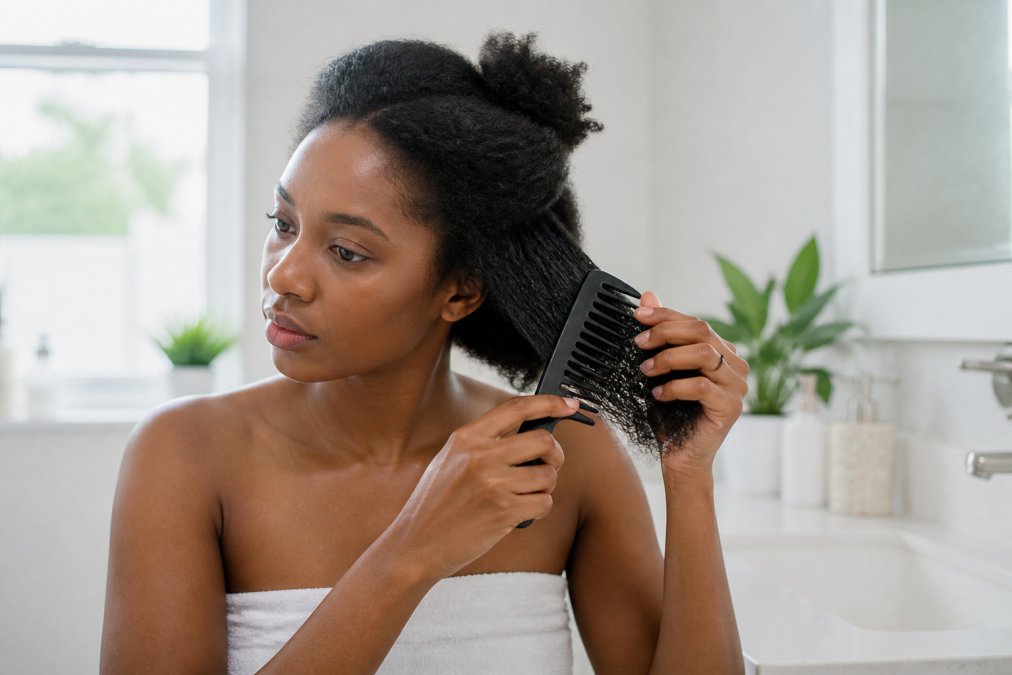
Total time: 60-90 minutes Difficulty: Beginner
Step 1: Pre-Poo and Detangle Gently
Work in four to six sections. Apply the AT Ease Moisturizing Hair and Skin Butter to dry hair first, since its slip helps the comb glide through knots instead of pulling. Then use a wide-tooth comb, starting at the ends and moving up. Never rip through tangles. Detangling on dry, product-free hair is the fastest way to snap strands.
Step 2: Cleanse with Sulfate-Free Shampoo and Deep Condition
The AT Ease Moisturizing Shampoo cleans without stripping natural oils, so hair that is already prone to breakage is not left dry and more likely to snap. Focus on the scalp, not the ends. After rinsing, apply a deep conditioning treatment and let it sit under a plastic cap. A steam treatment can help low-porosity hair absorb more. Rinse with cool water to help seal the hair cuticle.
Apply the AT Ease Quenched Leave-In Repair+ Spray to damp hair, section by section, to rehydrate strands and reinforce them against everyday friction. Follow with the AT Ease Moisturizing Hair and Skin Butter to seal that moisture in and coat each strand so it holds up better between wash days. For a full routine in one kit, the AT Ease Stimulating Moisture Hair Cream Gift Set includes shampoo, leave-in, moisture butter, and a scalp stimulator, so you can moisturize strands and support scalp circulation in one routine. Then style with low tension and let your hair rest.
Apply leave-in conditioner to damp hair, section by section. Follow with a butter or oil to seal in the moisture. For a full routine in one kit, the AT Ease Stimulating Moisture Hair Cream Gift Set includes shampoo, leave-in, moisture butter, and a scalp stimulator. Then style with low tension and let your hair rest.

Common Mistakes That Make Breakage Worse
The biggest mistake is treating breakage with more products instead of better technique. Adding layers of cream and oil onto damaged hair just causes buildup and more snapping.
Other mistakes that make things worse:
- Combing dry hair instead of damp, conditioned hair
- Skipping trims and letting split ends travel up the shaft
- Wearing the same tight style for weeks
- Using heat without protection
- Ignoring scalp health and internal factors
Frequently Asked Questions
How do I know if my hair is breaking or shedding?
Shed hair has a small white bulb at the root and is usually longer, while broken hair lacks the bulb and is shorter with uneven ends. Collect hair after detangling: if you see many short pieces without bulbs, it's breakage. Breakage often comes from dryness, friction, or protein-moisture imbalance. Adjust your routine with gentle detangling and moisture-boosting products to reduce breakage.
Can breakage hair grow back?
Yes, hair can grow back once you fix the cause of breakage. Hair follicles continue producing new strands unless there's a medical condition. Focus on moisture retention, protein-moisture balance, and low-tension protective styles. Regular trims remove split ends so they don't travel up the hair shaft. With consistent care, you'll see healthier growth over time.
What is the best protein treatment for natural hair breakage?
The best protein treatment depends on your hair's porosity and how much protein it needs. Look for hydrolyzed silk or wheat protein in leave-in conditioners, which strengthen without stiffness. For severe breakage, use a protein deep conditioner every 4-6 weeks, followed by a moisturizing deep conditioner to restore natural hair moisture balance. Avoid overuse, as too much protein makes hair brittle.
Which vitamin deficiency causes hair breakage?
Deficiencies in vitamin D, iron, zinc, and B vitamins can weaken hair and lead to breakage. However, most natural hair breakage comes from external factors like dryness, mechanical damage, and protein-moisture imbalance. If you suspect a deficiency, consult a doctor for blood work. A balanced diet supports hair health, but topical care is key for fixing breakage in natural hair.


